
Aircraft Jack Testing Requirements: Ensuring Safety And Regulatory Compliance
Diterbitkan:
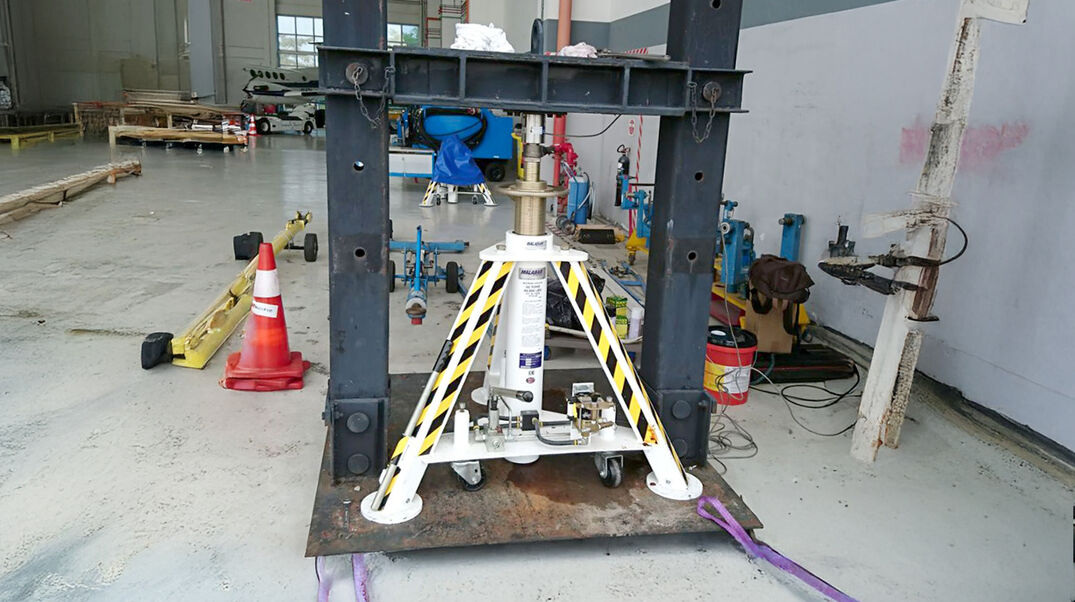
A jack may look like a simple piece of workshop gear, yet it carries one of the heaviest responsibilities in aviation: holding an aircraft safely while engineers work beneath or around it. When that support fails, the consequences can be severe. That is why testing is not a box-ticking exercise. It is a disciplined safety practice that protects people and assets. For operators, the right checks turn compliance into confidence.
A Guide To Safe And Compliant Aircraft Jack Testing:
1. Start with the manufacturer’s rated capacity and usage limits.
Every tripod, axle or associated lifting device has a defined safe working load, stroke range, contact point and operating method. Before any inspection begins, the team should confirm the model, serial number, capacity plate, service history and applicable manual. This prevents the common mistake of treating all units alike. A wide-body tripod jack, a compact axle unit and a specialist support stand may serve related purposes, but their acceptance criteria are not identical. The test should match the equipment, not assumptions.
2. Set a clear schedule before the equipment becomes overdue.
The required interval depends on the asset type, intensity of use, manufacturer guidance, company procedures and local workplace safety obligations. High-use items in busy hangars may need closer attention than rarely deployed reserve units. Testing should also be arranged after major repairs, suspected overload, hydraulic leakage, accident impact, component replacement or long storage. For aircraft jack testing in Singapore , planning ahead is important because downtime can affect hangar slots, release schedules and manpower allocation.
3. Inspect the structure before applying load.
A reliable assessment starts with a thorough visual examination. Technicians should look for cracked welds, bent frames, corrosion, damaged threads, missing fasteners, distorted saddles, worn wheels, poor labelling and signs of unauthorised modification. Hydraulic hoses, seals, valves and pumps also need review. This stage often reveals issues that should be corrected before a proof or functional test is attempted. Applying force to an already compromised item can create a hazard instead of proving safety.
4. Check hydraulic performance and controlled movement.
Aircraft jacks must raise, hold and lower smoothly. Any jerky motion, drift under load, uneven extension or uncontrolled descent deserves immediate attention. The release valve should operate predictably, the ram should remain stable, and pressure behaviour should be monitored within accepted limits. These checks are essential because lifting performance is not only about maximum capacity. Maintenance crews need equipment that responds accurately during tasks such as wheel changes, landing gear work and levelling operations.
5. Use calibrated measuring instruments.
Load cells, gauges and related devices must be suitable for the expected range and traceable to recognised calibration standards. Uncalibrated instruments can give false assurance, which is often worse than no data at all. At Sky Aero, we provide jack load testing using a purpose-built rig for on-site testing of AC tripod jacks and axle jacks, supported by an MOM-approved/calibrated TEDA Load Cell, with a stated range from 1,000 kg to 50,000 kg. This helps customers verify lifting performance without unnecessary movement of heavy equipment.
6. Record results in a format that supports audits.
A proper documentation should include identification details, date, location, technician or examiner information, equipment condition, applied load, instrument details, readings, defects, corrective actions and the final pass or fail status. Records should be legible, retrievable and linked to the asset register. In aviation, a missing record can cause almost as much trouble as a failed item because it weakens evidence of control. Documentation turns a technical activity into a compliance trail.
7. Remove failed items from service without delay.
If a jack does not meet acceptance criteria, it should be clearly tagged, segregated and blocked from use until repaired, retested and released by an authorised person. Temporary fixes, informal approval or “one more lift” decisions have no place around aircraft. The right response protects technicians and prevents secondary damage to the airframe. It also shows regulators, customers and internal auditors that safety decisions are consistent, even under pressure.
8. Connect testing with wider maintenance planning.
Jack checks should not sit apart from aircraft equipment maintenance. They should feed into spare parts planning, hose replacement, seal kits, wheel assemblies, corrosion control and operator training. A well-managed programme reduces urgent breakdowns and improves workshop readiness. It also supports GSE maintenance, because jacks rarely work alone; they are part of a broader ground support system that includes power units, tugs, stands, loaders and specialist tools.
9. Choose support that understands aviation operations.
General lifting knowledge is useful, but aircraft work adds tighter tolerances, documentation expectations and safety consequences. The right partner should understand hangar constraints, on-site access, calibration discipline and the need for prompt reporting. When evaluating aircraft equipment testing services in Singapore, operators should look beyond price and ask how the provider handles traceability, equipment range, technical competence and response time.
10. Work with suppliers who can support the whole lifecycle.
Buying equipment is only the first step. Long-term value comes from availability of spares, training, modification advice, servicing support and practical troubleshooting. An aviation equipment supplier in Singapore, Sky Aero supports operators with ground support equipment, spare parts, load testing, load bank testing, training and recovery services. We understand that reliable support on the ground helps keep aircraft movement safe, efficient and compliant.
Conclusion:
Aircraft jack testing is ultimately about trust. Engineers must trust the equipment beneath the aircraft, managers must trust the records behind each asset, and operators must trust that every lift is performed within a controlled safety framework. Sky Aero ’s on-site support and aviation-focused expertise help operators maintain disciplined testing, reduce risk, stay regulation-ready and avoid unnecessary delays. Contact us today.